6 Scenic Places in Grand Prairie for Photos
You know that moment when you’re scrolling through your camera roll and… yikes. Blurry selfie, another blurry selfie, that weird angle that makes your chin look like it has a twin, and oh – there’s your lunch from Tuesday. Again.
We’ve all been there, haven’t we? Standing in front of what should be a gorgeous backdrop, holding your phone at arm’s length like some sort of modern-day scarecrow, desperately trying to capture something – anything – that doesn’t look like it was taken during a minor earthquake.
Here’s the thing though… Grand Prairie is absolutely *loaded* with stunning spots that practically beg to be photographed. I’m talking about places so naturally photogenic that even your most camera-shy friend (you know, the one who still covers their face when someone pulls out a phone) would end up looking like they stepped off the cover of a magazine.
But here’s where it gets tricky – and this is something I see all the time. People drive right past these incredible locations because they don’t know they exist. They’re heading to the same old spots everyone else goes to, fighting crowds for that one decent angle, when literally five minutes away there’s this hidden gem where the lighting is perfect and you’ll have the whole place to yourself.
Why Your Photos Matter More Than You Think
Look, I get it. Maybe you’re thinking, “It’s just a photo.” But actually… it’s not. Those pictures you take? They’re tiny time capsules. They’re proof you were there, that you experienced something beautiful. And honestly – especially if you’re on a health and wellness journey – celebrating those moments when you’re out exploring, being active, feeling good about yourself? That’s huge.
Plus, let’s be real for a second. We live in a world where your photos end up everywhere. Your dating profile, social media, that family group chat where your aunt somehow always manages to screenshot the worst possible frame from your videos (thanks, Aunt Carol). Wouldn’t it be nice to have some genuinely great shots in your arsenal?
And here’s something most people don’t think about – when you look good in photos, you feel good. It’s this weird psychological thing where seeing yourself looking happy and confident actually makes you… well, happier and more confident. It’s like a feedback loop of positivity.
The Grand Prairie Advantage
Grand Prairie has this interesting thing going for it that a lot of places don’t. It’s got enough urban development to be interesting and accessible, but it’s also surrounded by all this natural beauty that hasn’t been completely Instagram-ized yet. You know what I mean – those spots that haven’t been “discovered” by every influencer within a 50-mile radius.
The lighting here is particularly gorgeous during golden hour (that magical time about an hour before sunset when everything looks like it’s been dipped in honey). And because of how the city is laid out – with all these parks and water features scattered throughout – you’ve got options. Lots of them.
Whether you’re looking for that perfect spot for anniversary photos, trying to update your professional headshots without paying a fortune, or just want some really good pictures for once in your life… this city’s got you covered.
What You’re About to Discover
I’m going to walk you through six absolutely stunning locations that most people have no idea exist. We’re talking about spots where the backdrop does half the work for you, where the natural lighting is so good you’ll think someone’s following you around with a professional setup.
Some of these places are perfect for those spontaneous moments – you know, when you’re already out running errands and suddenly the light hits just right. Others are worth planning a little photo session around, maybe packing a picnic and making it a whole afternoon thing.
I’ll tell you exactly when to go for the best light, what angles work best, and those little insider tricks that can turn a decent photo into something you’ll actually want to frame. Because honestly? Life’s too short for mediocre photos when these gorgeous spots are sitting right there, waiting for you to discover them.
Why Location Matters More Than Your Camera
You know that friend who somehow makes every photo look like it belongs in a magazine? The one who could probably take a stunning shot with a flip phone from 2005? Here’s the thing – it’s not always about having the fanciest equipment. More often than not, it’s about knowing where to point that camera.
Grand Prairie sits in this interesting sweet spot between Dallas and Fort Worth, and honestly, a lot of people just… drive through it. They’re missing out, though. This city has these pockets of unexpected beauty – the kind of places that make you pull over and think, “Wait, where exactly am I again?”
Think of location scouting like shopping for the perfect outfit. You could have the most expensive designer dress in the world, but if you wear it to a muddy music festival… well, you get the idea. The setting makes or breaks the whole thing.
Understanding Natural Light (Without Getting Too Technical)
I’m not going to bore you with a physics lesson about golden hour calculations – honestly, half the photography “rules” out there make my head spin too. But here’s what actually matters: the light in Texas can be… dramatic.
That harsh midday sun? It’s not your friend when you’re trying to get a flattering portrait. It creates these unflattering shadows under eyes and makes everyone squint like they’re solving complex math problems. But catch that same person during the hour before sunset, and suddenly they look like they stepped out of a movie.
Grand Prairie’s geography works in your favor here. With all those open spaces and water features, you’ve got natural reflectors bouncing light around. It’s like having a photography assistant you didn’t have to pay for.
The Art of Composition (It’s Simpler Than You Think)
Remember playing tic-tac-toe as a kid? That grid you’d draw – that’s basically the rule of thirds in photography. Instead of putting your subject smack dab in the center of every shot (which, let’s be honest, we all do instinctively), try placing them along those imaginary grid lines.
But here’s where it gets interesting in Grand Prairie specifically – this city gives you layers. You might have a beautiful lake in the foreground, some trees in the middle, and that expansive Texas sky stretching behind everything. It’s like looking at one of those old ViewMaster slides where everything has its place and depth.
Sometimes the most compelling photos break the rules entirely, though. Don’t get so caught up in the “shoulds” that you miss the magic happening right in front of you.
Seasonal Changes and Timing
Texas seasons are… well, they’re not exactly like what you see in New England postcards. We don’t get those picture-perfect fall foliage displays (though we do get some lovely color changes if you know where to look). What we do get are these subtle shifts that can completely transform a location.
Spring brings wildflowers – and I mean serious wildflowers. Those fields that look pretty ordinary most of the year suddenly burst into color. Summer means everything’s lush and green, but also… hot. Really hot. Fall offers the best light, hands down. And winter? People underestimate Texas winters for photography, but there’s something beautiful about bare trees against that endless sky.
The timing thing goes beyond seasons, too. Early morning mist over water features, late afternoon storms brewing in the distance, that magical blue hour just after sunset when the sky turns into this incredible gradient – these moments don’t last long, but they’re worth planning around.
Equipment Reality Check
Let’s just address the elephant in the room – you don’t need a camera that costs more than your car to take beautiful photos in Grand Prairie. Your smartphone is probably more capable than you realize. The real magic happens when you slow down, really look at what’s in front of you, and wait for the right moment.
That said, if you’re getting serious about photography, understanding your gear helps. But honestly? I’ve seen people take breathtaking shots with basic equipment simply because they understood their location and waited for good light. It’s like cooking – the fanciest pans in the world won’t save you if you don’t understand the fundamentals.
Pack Smart for Those Perfect Shots
You know what I’ve learned after dragging my camera gear around Grand Prairie more times than I can count? The right preparation makes all the difference between getting that Instagram-worthy shot and… well, wishing you had.
First things first – timing is everything. The golden hour (that magical time just after sunrise or before sunset) transforms even the most ordinary spots into something spectacular. Lynn Creek Park looks completely different at 7 AM versus noon, trust me. And here’s a secret the locals know: weekday mornings are your friend. You’ll have places like Lone Star Park practically to yourself, without having to photoshop out dozens of people from your shots.
Weather apps are nice, but they don’t tell you about the micro-climates around Joe Pool Lake. The area near the dam can be surprisingly windy even on calm days, so bring lens wipes and maybe a lightweight tripod that won’t topple over. I learned this the hard way during what should have been a perfect sunset shoot.
Essential Gear That Actually Matters
Look, you don’t need thousands of dollars worth of equipment – but you do need the right basics. A polarizing filter is worth its weight in gold around all that water we’ve got here. It’ll cut through glare and make those lake shots pop with color you didn’t even know was there.
Speaking of water… Grand Prairie’s humidity can fog up your lens faster than you’d think, especially during those gorgeous misty mornings. Keep a few silica gel packets in your camera bag – seriously, this tiny detail has saved more shoots than I care to admit.
Your phone camera? It’s probably better than you think, especially for quick shots and social media. But here’s the thing – invest in a decent phone tripod and maybe a wide-angle lens attachment. The Prairie Lights display looks completely different when you can capture more of the scene without having to stand halfway across the parking lot.
Location-Specific Insider Tips
Each spot in Grand Prairie has its own personality, and knowing these little quirks can make or break your photo session.
At Trader’s Village, the lighting changes dramatically depending on which side of the market you’re on. The western booths get harsh afternoon sun that’ll wash out your colors, while the eastern sections stay nicely shaded. Plus, vendors are usually more relaxed about photos in the morning before the crowds hit.
Fish Creek Linear Park is gorgeous, but here’s what nobody tells you – the trail markers make excellent foreground elements for composition. Use them to lead the eye through your shot instead of just shooting around them. And that wooden bridge everyone photographs? Try shooting from underneath it looking up – completely different perspective that most people miss.
The Uptown area is tricky because of all the mixed lighting from buildings and streetlights. If you’re shooting at dusk (which you absolutely should), bracket your exposures. Take multiple shots at different settings – you’ll thank me later when you’re editing.
Making the Most of Each Season
Grand Prairie doesn’t just look different throughout the day – it transforms completely with the seasons, and each one offers unique opportunities you won’t want to miss.
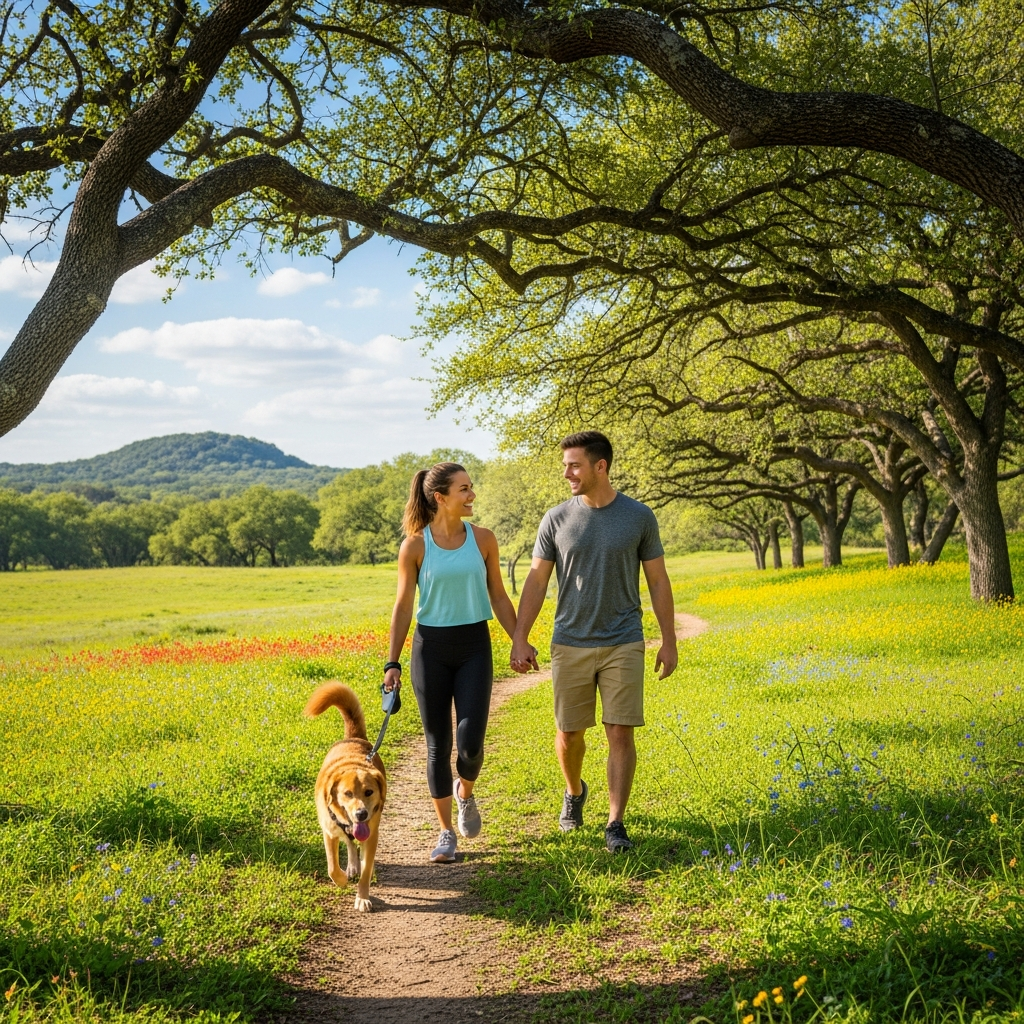
Spring brings those incredible wildflower blooms along the trails, but they’re fleeting. We’re talking maybe two weeks of peak color, typically in late March or early April. The trick is to get low – like, lying-on-the-ground low – and shoot up through the flowers with the sky as your backdrop.
Summer might seem challenging with the heat, but those afternoon thunderstorms create the most dramatic skies you’ll see all year. Keep an eye on weather radar and position yourself safely for some incredible storm cloud photography. Joe Pool Lake during summer storms? Absolutely stunning.
Fall colors around Fish Creek aren’t as intense as you’d see up north, but the subtle changes are beautiful if you know how to capture them. Look for the contrast between the changing trees and the evergreens – that’s where the magic happens.
Winter in Grand Prairie might surprise you. When we do get that rare snow or ice storm, everything becomes a completely different world. Just be extra careful about your footing and protect your gear from moisture.
The Real Secret? Patience and Persistence
Here’s the truth nobody wants to tell you – the best shots often come from returning to the same spot multiple times. That perfect light, the interesting weather, the moment when everything just clicks… it rarely happens on your first visit. Give yourself permission to scout, to experiment, to come back when conditions are better.
When Your Camera Phone Just Won’t Cooperate
You know that feeling when you’re standing in front of something gorgeous – maybe it’s the golden hour light hitting the water at Joe Pool Lake – and your phone camera makes it look like a blurry mess? Yeah, we’ve all been there. The truth is, phone cameras struggle with certain conditions that are actually pretty common in Grand Prairie’s scenic spots.
Bright sunlight creates harsh shadows that’ll turn your beautiful portrait into something that looks like you’re hiding under a rock. And don’t even get me started on trying to capture those stunning sunset colors at Lynn Creek Park… your phone usually decides to either blow out the sky completely or make everything else look like it was shot in a cave.
Here’s what actually works: use your phone’s HDR mode (that’s usually in the camera settings), but here’s the catch – you need to hold really, really still. Like, unnaturally still. I’m talking statue-level stillness for about three seconds. Also, tap on different parts of your screen to change where the camera focuses and adjusts exposure. It’s not intuitive, but it makes a huge difference.
Dealing with Other People (Because They’re Everywhere)
Let’s be honest about something nobody talks about in those photography guides – other people exist, and they’re probably trying to take the exact same photo you are. Fish Creek Linear Park on a Saturday morning? Good luck getting a clean shot without someone’s kid on a scooter bombing through your frame.
The popular spots like the Trinity River Trail get crowded, especially during those magical golden hours when the light is actually good for photos. You’ll show up thinking you’ve discovered some hidden gem, only to find twelve other people with the same idea.
Your best bet? Go early. I mean really early – like 7 AM early. Or embrace the chaos and make people part of your story. Sometimes the best photos happen when you stop fighting the crowds and start incorporating them. That candid shot of families enjoying the lake might be better than the pristine landscape you were planning anyway.
Weather Will Ruin Your Plans (Plan for It)
Texas weather is… unpredictable. You’ll check the forecast, see sunny skies, drive all the way out to Prairie Creek Park, and suddenly there’s a wall of clouds that makes everything look flat and gray. Or worse – wind that turns your carefully planned outdoor portrait session into a hair disaster.
But here’s something I learned the hard way: overcast days are actually amazing for portraits. That gray sky? It’s like having a giant softbox over everything. Your skin looks smooth, colors are saturated, and you don’t have to squint. Those moody, cloudy shots at the Grand Prairie Marina can be absolutely stunning.
Keep a light jacket in your car for wind, and honestly? Sometimes the best photos happen when weather doesn’t cooperate. Rain puddles make incredible reflections, and dramatic clouds add way more interest than a boring blue sky.
The Equipment Trap (You Don’t Need More Stuff)
There’s this weird pressure to upgrade your gear when you’re not happy with your photos. Trust me, I’ve seen people lug massive cameras and tripods out to Lone Star Park, only to take photos that aren’t any better than what they could’ve gotten with their phone.
The real issue usually isn’t your equipment – it’s timing and patience. That expensive camera won’t magically make you better at composition or teach you when the light is right. Start with what you have and learn to use it well.
If you’re dead set on upgrading, get a small portable tripod first. Not for the fancy shots, but because it forces you to slow down and actually think about your composition instead of just snapping away.
Finding Your Own Angle in Familiar Places
Here’s the thing about Grand Prairie’s scenic spots – they’ve been photographed. A lot. That iconic shot from the dock at Joe Pool Lake? Yeah, it’s been done. The challenge isn’t finding beautiful places (they’re everywhere), it’s finding your own perspective on them.
Get low. Get high. Move three feet to the left. Sometimes the most interesting photo isn’t the obvious one everyone takes, but the detail shot of morning dew on the prairie grass, or the reflection in a puddle after it rains.
The best photos often happen when you stop trying so hard to get “the shot” and start noticing the little moments happening around you.
What to Expect When You Start Shooting
Here’s the thing about photography – and I wish someone had told me this earlier – you’re not going to nail every shot right away. Even in these gorgeous Grand Prairie locations, there’s a learning curve that comes with understanding how light hits the water at Joe Pool Lake or figuring out the best angle for those sprawling prairie views.
Your first few outings? They’ll probably feel a bit overwhelming. You’ll arrive at Lynn Creek Park with your camera, see all these beautiful possibilities, and… freeze up a little. That’s totally normal. I’ve watched countless photographers go through this exact moment – standing there with amazing scenery in front of them, wondering where to even start.
Give yourself permission to take mediocre photos at first. Really. Those shots where the horizon isn’t quite level or the lighting feels off? They’re not failures – they’re your foundation. Every photographer I know has a folder (okay, several folders) of photos that didn’t quite work out. But each one taught them something.
Your First Month: Building Confidence
In your first few weeks of exploring these spots, focus on getting comfortable with your camera settings rather than creating portfolio pieces. Visit the same location multiple times if you need to – there’s no shame in returning to Lone Star Park until you really understand how the light changes throughout the day.
You might find yourself gravitating toward one particular spot. Maybe it’s the quiet corners of Fish Creek Linear Park, or perhaps you’re drawn to the dramatic skies over the prairie areas. That’s perfectly fine. Actually, it’s more than fine – it’s smart. Getting to know one location intimately will teach you more about photography than rushing through all six spots superficially.
Don’t worry if your friends are posting seemingly perfect shots on social media while you’re still figuring out basic composition. Social media is… well, it’s social media. People share their best work, not their learning process. Behind every stunning photo you see online are probably dozens of attempts that didn’t quite hit the mark.
Making Real Progress: Months 2-6
This is where things start getting interesting. You’ll begin noticing patterns – how certain weather conditions create better photos at the lake, or which times of day make those prairie landscapes really sing. Your eye will start developing, and you’ll find yourself seeing photographic opportunities you completely missed before.
Around month three or four, you might hit what I call the “comparison wall.” You’ll start looking at your work more critically, maybe feeling like you’re not improving fast enough. This is actually a good sign – it means your artistic eye is developing faster than your technical skills. The gap will close, but it takes patience.
Consider keeping a simple photo journal during this phase. Nothing fancy – just notes about what worked, what didn’t, and what you want to try next time. When you’re at Joe Pool Lake and the sunset creates this incredible golden reflection, jot down the time, weather conditions, and camera settings. Trust me, you’ll forget otherwise.
Building Your Own Style: 6+ Months
By now, you’ll start developing preferences that feel uniquely yours. Maybe you’re drawn to the moody, overcast days at the parks, or perhaps you love the challenge of bright, contrasty afternoon light on the prairie. These preferences aren’t random – they’re your artistic voice starting to emerge.
This is when you might consider sharing your work more broadly, entering local photography contests, or even printing a few favorites. But remember – there’s no rush. Some photographers develop their style quickly, others take years. Both paths are valid.
Next Steps That Actually Matter
Instead of overwhelming you with a massive to-do list, here are three realistic next steps
Pick two locations from our list and commit to visiting them regularly over the next month. Deep beats wide every time.
Connect with one local photographer or join a Grand Prairie photography group. Having real people to learn from makes all the difference.
Set a small, achievable goal – maybe it’s taking one photo you’re genuinely proud of each week, or learning to use manual mode consistently.
The beautiful thing about these Grand Prairie locations is they’ll be there tomorrow, next month, next season. There’s no deadline for becoming the photographer you want to be. Just start where you are, with what you have, and let these scenic spots teach you as you go.
You know what strikes me most about these beautiful spots around Grand Prairie? It’s not just that they’re Instagram-worthy (though they absolutely are) – it’s how stepping into these spaces can shift something inside you. There’s this weird magic that happens when you’re standing by the lake at Lynn Creek Park, watching the light dance on the water, or catching your breath after climbing those trails at Joe Pool Lake… suddenly, you’re not just thinking about the next meal or the number on the scale.
I’ve noticed this with so many of our patients – and honestly, with myself too. When you’re focused on capturing that perfect sunset shot or trying to frame the wildflowers just right, your mind gets this little break from the constant chatter about weight, food, and all those things that can feel so overwhelming. It’s like your brain finally exhales.
And here’s something I find really beautiful: these aren’t fancy, exclusive places that require special memberships or expensive gear. They’re right here, waiting for you. Whether you’re dealing with 20 pounds or 200, whether you’re just starting to think about your health or you’ve been on this path for years – these spaces welcome everyone exactly as they are right now.
The movement that happens naturally when you’re exploring – walking those trails, climbing for a better angle, even just standing and taking in the view – it doesn’t feel like “exercise” in that dreaded way. It feels like living. Like being human. And sometimes, that’s exactly what we need to remember we are.
I love how photography gives you this gentle excuse to slow down, too. You’re not rushing through a workout or forcing yourself through another day of restrictions. You’re… present. Looking at light, noticing details, maybe even seeing yourself differently through the lens.
These spots we’ve talked about – from the peaceful moments at Fish Creek Linear Park to the surprising discoveries at the Grand Prairie Premium Outlets area – they’re all part of something bigger. They’re reminders that taking care of yourself doesn’t have to feel like punishment. It can feel like curiosity, like adventure, like coming home to yourself.
But you know what? Sometimes the hardest part isn’t finding beautiful places to visit – it’s believing you deserve to feel good in your own skin while you’re there. If you’re struggling with that piece, if the weight loss journey feels lonely or overwhelming, or if you’re just tired of trying to figure it all out on your own… we get it. Really.
You don’t have to have all the answers before you reach out. You don’t need to be “ready” or have your life perfectly together. Sometimes the bravest thing is just saying, “I could use some support here.”
If any of this resonates with you – the desire to feel more at home in your body, to find joy in movement, to discover what taking care of yourself can actually feel like – we’d love to talk with you. No pressure, no judgment, just real people who understand that this stuff is complicated and you’re worth figuring it out.